
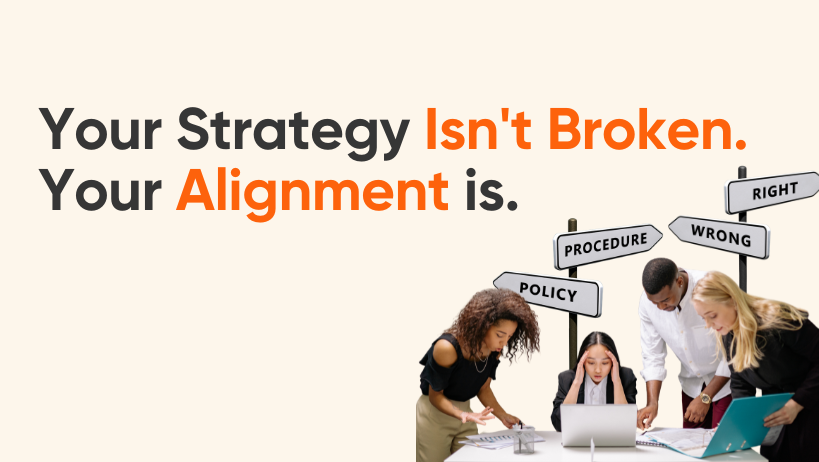
The Gap Between What Leaders Say and What Organisations Do
You spent months building the strategy.
The leadership team sat in the room. The decisions were made. Everyone left aligned — or so it felt.
Six months later, the results told a different story.
Deadlines slipped. One at a time, barely noticeable at first. Every team seemed to add priorities rather than commit to fewer. Departments pulled in directions that looked nothing like the plan on paper (I still use paper and recommend it). And the strategy — the one the whole team had agreed on — slowly disappeared into the gap between intention and reality.
The frustration that follows is a specific kind. Not the clean frustration of conflict or dissent. The harder kind — when you cannot identify what went wrong, because everything looked right.
A CEO we worked with described it this way. “I knew something was off. I could feel it in every meeting. But every time I tried to put my finger on it, it moved. My team said the right things. The reports looked acceptable. The direction seemed right, mostly. But we were not moving the way we should have been. And I did not know why.”
That uncertainty — that confusion of sensing a problem you cannot pin down or name — is one of the most isolating experiences in leadership. The responsibility is total. The visibility is incomplete. And the instinct to blame execution, or the market, or the plan itself, is almost irresistible.
But the strategy was not the problem. It never was.
The problem was alignment. The gap between what the leadership team said in the room — and what each individual held, prioritised, and acted on when they left it. How they communicated with their teams. With suppliers. With clients.
That gap is invisible to traditional measurement. It does not appear on operating reports or balance sheets. It does not flag itself in a board review. It hides in the ordinary — in decisions that take too long, in priorities that contradict each other, in communication that performs alignment without producing it.
The signs are always there. But without the right tool, leadership cannot connect the dots.
Go deeper: The Signs of Executive Misalignment Nobody Talks About
The Real Cost of a Misaligned Leadership Team
Here is the number most organisations cannot calculate.
A 0.5% misalignment between C-Suite executives — barely detectable, easily dismissed — compounds into a 15% performance loss within twelve months.
Fifteen percent.
On a business turning fifty million, that is seven and a half million disappearing. Not from a failed strategy. Not from a market shift. Not from an operational breakdown. From invisible friction — often starting at the top — that nobody measured, because nobody had a tool designed to measure it. Hard to solve when we do not know what we do not know.
The cost lands across four dimensions.
Time.
Misaligned teams spend a disproportionate amount of time in alignment-seeking behaviour — repeated meetings, revisited decisions, escalations that should never reach the C-Suite. That time is not free. It belongs to strategy, growth, and the decisions that matter.
Talent.
High performers beneath a misaligned leadership team feel the friction before they can name it. They slow down. They protect themselves. The best ones leave. The cost of replacing a senior leader sits between one and three times their annual salary — in the hope that the next hire will be the right one. Misalignment at the top is one of the most consistent invisible causes of talent loss — and one of the least recognised.
Speed.
Aligned organisations execute faster. Not because they work harder. Because they waste nothing on internal resistance. Every degree of misalignment is a degree of organisational velocity lost — quietly, consistently, compounding over time.
Reputation.
Clients, partners, and investors read organisations more accurately than those organisations read themselves. Inconsistency at the top surfaces in inconsistent messaging, inconsistent delivery, and inconsistent results. Trust erodes. And by the time it becomes visible, the damage is already deep.
The disappointment of watching a good strategy underperform. The stress of carrying accountability for results that refuse to materialise. The quiet fear that the problem is somehow unfixable — because it cannot be seen, let alone solved.
These are not abstract concerns. They are the lived reality of leadership teams operating in misalignment — often for years — without ever understanding the root cause.
And yet the tools most organisations rely on to measure performance were never designed to surface this problem.
From Misalignment to Measurable Performance — The Revolving Change Approach
Knowing the gap exists is the beginning. Closing it is the work.
But before anything can change, one thing must happen first. The real landscape must become visible. Tangible.
Not the landscape the leadership team believes exists. Not the one presented in strategy sessions or board meetings. The landscape driving real decisions, real priorities, and real behaviours every day.
A leadership team we worked with had operated for three years with what they described as strong internal alignment. They were experienced. They were capable. They trusted each other. When asked individually to describe the organisation’s top three strategic priorities — in private, without consultation — no two executives gave the same answers.
Not approximately the same. Not differently worded versions of the same thought.
Different answers.
The surprise and frustration in the room when those responses were mapped side by side was immediate. So was something else — relief. Because for the first time, the problem had a shape. It could be seen. And what can be seen can be addressed.
That is what Corporate Dynamic Profiler™ was designed to do.
It is the first KPI built specifically for C-Suite and business alignment. Not for individual performance. Not for team culture or engagement. For alignment — the degree to which the leadership team holds the same priorities, interprets strategy the same way, and will make consistent decisions independently, without the others in the room.
Corporate Dynamic Profiler™ is administered across the full scope agreed with the client — a single team, a division, or an entire multinational organisation. In multi-site and multinational organisations, it will also measure and gauge how aligned those entities are — often involving Tier 1 suppliers and selected blue-chip customers. Each participant responds independently. The results are mapped, compared, and presented as a precise picture of where the organisation stands — not where it believes it stands. That picture becomes the foundation for everything that follows.
And because conditions change, teams evolve, and organisations grow — Corporate Dynamic Profiler™ is not a one-time exercise. It is applied over time. What it reveals at one moment will differ from what it reveals twelve months later. Alignment is not a destination. It is a dynamic condition that can derail quietly, slowly at first — and with devastating impact if left unattended.
There is one dimension of this challenge that is accelerating faster than any other — and is almost entirely absent from the conversation. Artificial intelligence is being deployed across organisations at a pace that leadership teams are struggling to match. Budgets are committed. Platforms are selected. Pilots are running. But whether the C-Suite is actually aligned on what AI means for the business — the risk it carries, the pace it demands, the investment it requires, the impact it will have on people, process, and competitive position — is a question almost nobody is asking. Each executive holds a view. Those views are rarely mapped, rarely compared, and never measured. The technology gets a deployment plan. The alignment to it does not. Corporate Dynamic Profiler™ is the only tool that closes that blind spot — before the gap between assumed and actual AI alignment becomes the next invisible drag on performance.
From the results, Revolving Change recommends a course of action where necessary. The client decides whether to proceed. If they do, the work deepens — through a structured methodology built on decades of understanding how organisations change, and what it takes to make that change last.
That methodology is our DISCOVER, DESIGN, and DELIVER — moving from diagnosis through tailored programme design to live implementation and measurable results.
The courage it takes to invite that level of honest measurement is itself a defining quality of the leaders who achieve the most. Not because the results are always comfortable. But because clarity — even when difficult — is always more valuable than the comfortable fog of assumption.
Go deeper: The Difference Between Assumed Alignment and Measured Alignment →
Alignment Is Not a Feeling. It Is a Decision.
Every C-Suite team believes it is aligned.
The belief is understandable. These are intelligent, experienced, committed leaders. They have debated together, decided together, and built something together — many times over. The feeling of alignment is real. Experience, and the absence of a concrete measurement reference, makes misalignment almost inconceivable. “We always work extremely well together,” is what we hear. And they mean it. Beyond doubt.
But feeling is not measurement. And in the absence of measurement, misalignment compounds in silence — meeting by meeting, quarter by quarter — until the gap between intention and outcome becomes impossible to ignore.
For most leadership teams, alignment has always been a feeling. Corporate Dynamic Profiler™ changes that. For the first time, it becomes something measurable, manageable, and demonstrable — a foundation built on data rather than confidence.
The organisations that will define the next decade are not the ones with the most sophisticated strategies. Strategies are available to everyone. They are the ones with the leadership alignment to execute those strategies with precision and consistency — ensuring that alignment percolates across the entire organisation — and the discipline to measure it, not merely assume it.
That does not happen by accident.
It is a decision. A decision to see what has always been there. To measure what has always been assumed. To replace the comfortable fog of collective confidence with the clarity that only honest measurement can produce.
Revolving Change exists for that decision. And for the leaders who are ready to make it.
IS YOUR ORGANISATION ALIGNED — OR DOES IT FEEL THAT WAY?
There is only one way to know. Book a confidential briefing with Revolving Change. We will show you exactly how we determine where your organisation stands — and what that means for the results you are working to achieve.