
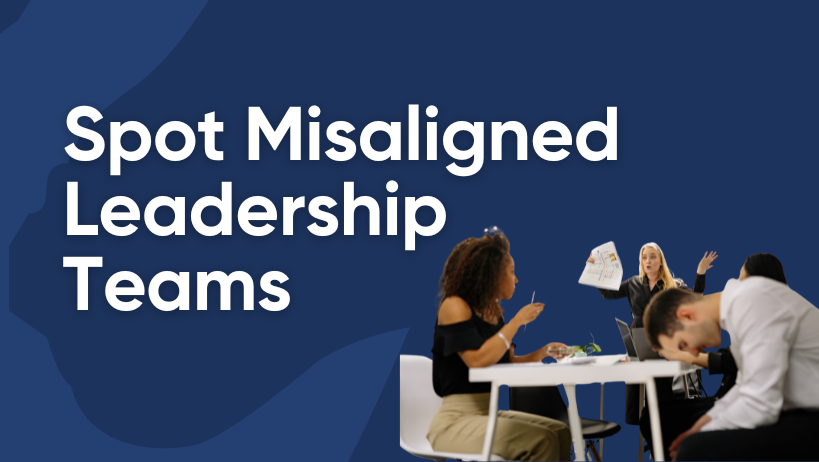
When Something Feels Off But Cannot Be Named
Most C-Suite teams never have a conversation about misalignment.
Not because it does not exist. Because it is almost impossible to name while you are inside it.
A CEO we worked with put it this way. “I kept telling myself it was a phase. That once we got through the quarter, things would settle. They never did. And I realised at some point that I had been saying that for two years.”
That is what misalignment does. It does not create a crisis. It creates drift — slow, quiet, compounding. The kind that is easy to explain away in any single meeting but impossible to ignore when you look at twelve months of results.
The frustration is not the absence of effort. Everyone is working. Everyone believes they are moving in the right direction. The frustration is the gap between that effort and the outcomes it should be producing.
Before misalignment can be solved, it must be seen. And before it can be seen, it must be recognised for what it is — not a performance problem, not a communication style issue, not a personality clash. A gap in shared understanding at the top of the organisation.
These are the signs.
This article is part of the C-Suite Alignment cluster. Read the Pillar Article first: [Your Strategy Isn’t Broken. Your Alignment Is. →]
The Signals Hidden in Plain Sight
Misalignment does not arrive as a single event. It accumulates through patterns — patterns that seem manageable in isolation, but together describe an organisation pulling against itself.
The first pattern is decision revisiting. The leadership team agrees on a direction in a meeting. Two weeks later, a different conversation produces a slightly different direction. Nobody remembers contradicting themselves. Everyone believes they are being consistent. The organisation underneath absorbs the contradiction and calls it normal. Pattern changes over time are often imperceptible.
The second pattern is priority multiplication. One executive is driving growth. Another is managing risk. A third is focused on operational efficiency. All three believe they are executing the same strategy. None of them are wrong about their own priorities — but none of them are aligned either. The result is an organisation simultaneously accelerating and braking.
The third pattern is communication that performs rather than connects. Leaders say the right things in the right rooms. The language of alignment is present. The reality of it is not. Decisions made outside the room — in emails, in side conversations, in resourcing choices — follow a different logic entirely.
A manufacturing firm we worked with had a leadership team that scored themselves nine out of ten on alignment in an internal survey. When their actual resource allocations were mapped against their stated strategy, the real picture was closer to six. The gap between perception and reality had been compounding for eighteen months. Nobody had noticed because everybody had been looking at the wrong signals.
The right signals are not in the survey. They are in the decisions.
Why C-Suite Teams Mistake Performance for Alignment
There is a specific trap that experienced leadership teams fall into.
When results are acceptable — not exceptional, but acceptable — it is easy and common to interpret that as confirmation that the team is functioning well. The organisation is moving. Revenue is coming in. Nobody is openly in conflict. Alignment is assumed. It is actually not on anyone’s radar.
What is happening is something different. The organisation is performing despite misalignment — not because of alignment. The gap is being covered by individual effort, by strong middle management, by a market that is forgiving enough to absorb internal friction. That cover never holds indefinitely.
What makes this trap dangerous is that it feels like success. A leadership team in this situation will describe themselves as high-performing. They will point to results as evidence. And they will not be lying. The results are real. What they cannot see is the results that are missing, the squandered potential — the velocity, the precision, the compounding advantage that aligned organisations accumulate over time.
This is where Corporate Dynamic Profiler™ changes the question. Not by measuring performance — there are tools for that, and many of our clients use them effectively. Corporate Dynamic Profiler™ measures alignment — the underlying condition that determines whether performance will improve or erode. Like any KPI, it is most powerful when applied at regular intervals — not as a one-time diagnosis, but as a continuous alignment indicator.
Skills-B-Hive™ adds the second dimension. When misalignment is substantial and management skills are less than adequate, misalignment is never just a structural problem — it is a human one. It lives in the specific range and depth of skills each executive brings to the team — and in how those skills support or undermine each other. That dynamic is unique to every executive and shifts as business conditions change. Understanding those interdependencies is what separates a real solution from a generic one.
Go deeper: The Real Cost of Misalignment: What It Is Silently Costing Your Organisation →
What Happens When the Signs Are Ignored
The trajectory is consistent. Not dramatic. Consistent.
In the first phase, the signs are subtle enough to explain away. Missed deadlines have visible causes. Conflicting priorities are attributed to complexity. Communication breakdowns are treated as interpersonal friction rather than structural misalignment. Leaders manage the symptoms and move on. Nothing to see here.
In the second phase, the cost becomes harder to ignore. Talent begins to leave. Not in a wave — one resignation at a time, each one with a plausible explanation, scapegoats appear. Strategy execution slows. Initiatives that should take a quarter take three. The board begins to notice the gap between commitment and delivery.
In the third phase, the organisation is in repair mode. The cost now includes not just performance loss but leadership credibility, team cohesion, and the time and resource required to rebuild what misalignment has eroded. Revenue deterioration and loss of market share start punching the various KPIs. This is the phase where organisations bring in external consultants, restructure teams, and begin the expensive process of diagnosing a problem that was present — and measurable — years earlier.
The difference between organisations that catch it early and those that do not is not intelligence or effort. It is measurement. The ones that catch it early have deployed Corporate Dynamic Profiler™ — a tool that surfaces the gap before it becomes a crisis. The ones that do not are managing by feel — and feeling, in the absence of data, is unreliable.
Seeing It Is the First Step to Solving It
The signs of executive misalignment are not always hidden. They are not being looked for in the right places.
They are in the decisions that get made and then remade. In the priorities that multiply instead of focusing. In the communication that performs alignment in the room and produces something different outside it. In the results that are just acceptable but never what they should be.
Every leadership team believes it is aligned. It is normal and common. That belief is not a failure of intelligence — it is the natural consequence of never having had a tool that shows the gap between what is assumed and what is real.
Corporate Dynamic Profiler™ is that tool. It does not ask how the team feels about alignment. It measures it — across every dimension that determines whether a strategy will execute with precision or disappear into the gap between intention and reality.
Seeing the gap is not comfortable. But it is always more valuable than not knowing it exists — and when you see it, action becomes a choice.
DO YOU KNOW WHERE YOUR MISALIGNMENT IS — OR ARE YOU MANAGING BY FEEL?
Book a confidential briefing with Revolving Change. We will show you exactly how Corporate Dynamic Profiler™ surfaces what traditional performance tools cannot see.